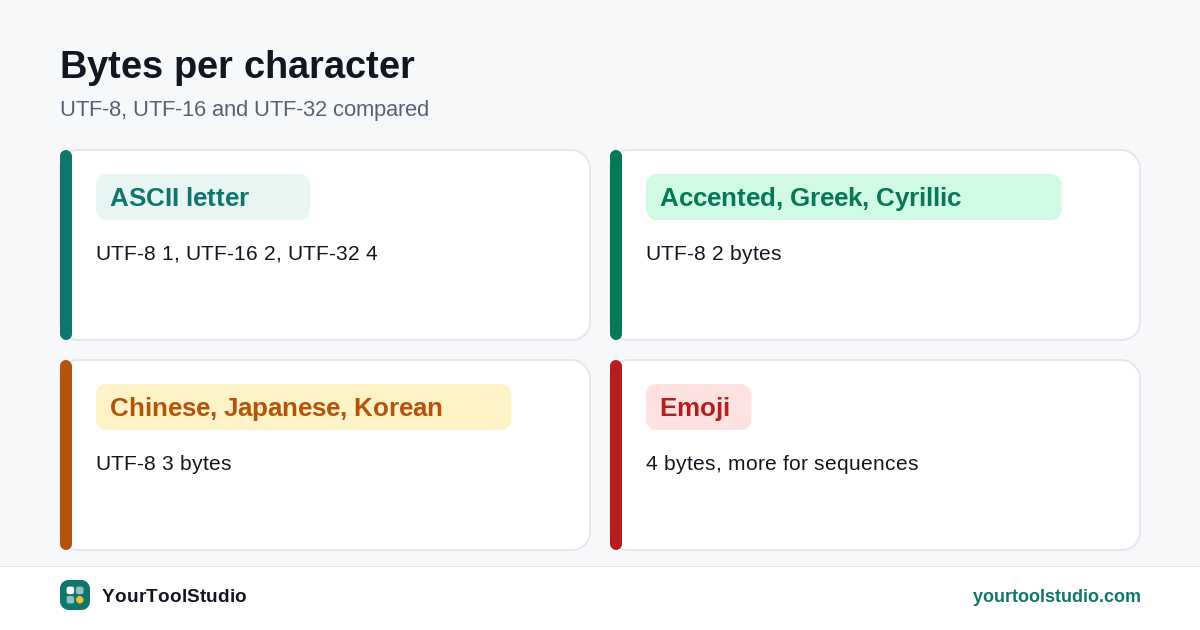
In UTF-8 a character takes 1 to 4 bytes: 1 for ASCII letters and digits, 2 for most accented Latin, Greek, Cyrillic, Hebrew and Arabic letters, 3 for most other scripts including Chinese, Japanese and Korean, and 4 for emoji and other characters above U+FFFF. In UTF-16 a character takes 2 or 4 bytes, and in UTF-32 always 4. These figures are per code point; a character you see on screen can be several code points, and the measured table below shows how much that adds. Standards checked on 27 November 2026.
Bytes per code point by encoding
The ranges below come from RFC 3629 for UTF-8 and RFC 2781 for UTF-16. The Unicode Consortium FAQ gives the same fewest and most bytes per character: 1 and 4 for UTF-8, 2 and 4 for UTF-16, and 4 and 4 for UTF-32.
| Code point range | What lives there | UTF-8 | UTF-16 | UTF-32 |
|---|---|---|---|---|
| U+0000 to U+007F | ASCII: English letters, digits, basic punctuation, control codes | 1 byte | 2 bytes | 4 bytes |
| U+0080 to U+07FF | Accented Latin, Greek, Cyrillic, Armenian, Hebrew, Arabic | 2 bytes | 2 bytes | 4 bytes |
| U+0800 to U+FFFF | Most other scripts (Devanagari, Thai, CJK, Hangul), plus symbols such as the euro sign | 3 bytes | 2 bytes | 4 bytes |
| U+10000 to U+10FFFF | Supplementary planes: most emoji, rare CJK, historic scripts, musical and maths symbols | 4 bytes | 4 bytes (surrogate pair) | 4 bytes |
The last row is why UTF-16 is not a fixed 2 bytes. RFC 2781 encodes any code point of U+10000 or above as two 16-bit units, the first in the range D800 to DBFF and the second in DC00 to DFFF. That pair is called a surrogate pair. The Unicode FAQ adds that UTF-8 must encode such a character as one 4-byte sequence, not as two 3-byte sequences for the two surrogates, even though some older software does the latter.
Measured sizes for real characters
We measured each of these with Node.js on 27 November 2026, using Buffer byte lengths for UTF-8 and UTF-16 and code point counts for UTF-32. "Seen as" is the number of characters a reader perceives, counted with the Intl.Segmenter grapheme rules that browsers use.
| Character | Code points | Seen as | UTF-8 | UTF-16 | UTF-32 | UTF-8 bytes (hex) |
|---|---|---|---|---|---|---|
| A | U+0041 | 1 | 1 | 2 | 4 | 41 |
| é (one code point) | U+00E9 | 1 | 2 | 2 | 4 | C3 A9 |
| é (e + combining accent) | U+0065 U+0301 | 1 | 3 | 4 | 8 | 65 CC 81 |
| ß | U+00DF | 1 | 2 | 2 | 4 | C3 9F |
| Ω (Greek) | U+03A9 | 1 | 2 | 2 | 4 | CE A9 |
| Я (Cyrillic) | U+042F | 1 | 2 | 2 | 4 | D0 AF |
| א (Hebrew) | U+05D0 | 1 | 2 | 2 | 4 | D7 90 |
| ع (Arabic) | U+0639 | 1 | 2 | 2 | 4 | D8 B9 |
| € | U+20AC | 1 | 3 | 2 | 4 | E2 82 AC |
| ™ | U+2122 | 1 | 3 | 2 | 4 | E2 84 A2 |
| अ (Devanagari) | U+0905 | 1 | 3 | 2 | 4 | E0 A4 85 |
| ก (Thai) | U+0E01 | 1 | 3 | 2 | 4 | E0 B8 81 |
| 中 (Chinese) | U+4E2D | 1 | 3 | 2 | 4 | E4 B8 AD |
| あ (Hiragana) | U+3042 | 1 | 3 | 2 | 4 | E3 81 82 |
| 한 (Hangul) | U+D55C | 1 | 3 | 2 | 4 | ED 95 9C |
| 😀 | U+1F600 | 1 | 4 | 4 | 4 | F0 9F 98 80 |
| 𝄞 (G clef) | U+1D11E | 1 | 4 | 4 | 4 | F0 9D 84 9E |
| ❤️ (heart + emoji style) | U+2764 U+FE0F | 1 | 6 | 4 | 8 | E2 9D A4 EF B8 8F |
| 👍🏽 (with skin tone) | U+1F44D U+1F3FD | 1 | 8 | 8 | 8 | F0 9F 91 8D F0 9F 8F BD |
| 🇬🇧 (flag) | U+1F1EC U+1F1E7 | 1 | 8 | 8 | 8 | F0 9F 87 AC F0 9F 87 A7 |
| 👨👩👧👦 (family) | 7: four people joined by three U+200D | 1 | 25 | 22 | 28 | 4 people x 4 bytes + 3 joiners x 3 bytes |
Whole strings compared
Measured the same way, a 13-character English greeting is 13 bytes in UTF-8, the same greeting in Russian (12 characters) is 21 bytes, and in Chinese (6 characters, including full-width punctuation) it is 18 bytes. As a rule of thumb, English text in UTF-8 is about 1 byte per character, European and Middle Eastern scripts about 2 per letter plus 1 per space and ASCII punctuation, and East Asian text about 3.
| Text | Characters | UTF-8 bytes | Bytes per character |
|---|---|---|---|
| Hello, world! | 13 | 13 | 1.0 |
| Привет, мир! | 12 | 21 | 1.75 |
| 你好,世界! | 6 | 18 | 3.0 |
What "one character" means in common systems
| Where | What a length or limit counts | Bytes per unit |
|---|---|---|
JavaScript .length | UTF-16 code units, per MDN, so 😀 has length 2 and the family emoji 11 | 2 |
MySQL utf8mb4 | Characters, up to four bytes each, covering supplementary characters | 1 to 4 |
MySQL utf8mb3 | Basic Multilingual Plane characters only, up to three bytes; supplementary characters such as emoji cannot be stored | 1 to 3 |
| Files saved as UTF-8 | Bytes on disk; an optional byte order mark adds EF BB BF at the start | 1 to 4 |
| Files saved as UTF-16 | Bytes on disk; a byte order mark adds FE FF (big-endian) or FF FE (little-endian) | 2 or 4 |
To count the characters a reader sees, use the Word Counter, which counts emoji sequences and combined accents as one character using the browser's grapheme rules. For how character counts turn into words, see how many words is 1000 characters, and for the 33 percent growth when bytes are turned into text, see Base64 size increase. The first 128 code points are listed in the ASCII table.
Sources and dates
| Source | Checked | Used for |
|---|---|---|
| Unicode Consortium: UTF-8, UTF-16, UTF-32 and BOM FAQ | 27 November 2026 | Fewest and most bytes per character, code unit sizes, byte order marks, 4-byte rule for supplementary characters |
| RFC 3629: UTF-8 | 27 November 2026 | UTF-8 code point ranges and byte patterns |
| RFC 2781: UTF-16 | 27 November 2026 | Surrogate pair ranges for code points above U+FFFF |
| MySQL 8.4 Reference Manual: utf8mb4 | 27 November 2026 | utf8mb4 and utf8mb3 maximum bytes and supplementary character support |
| MDN: String length | 27 November 2026 | JavaScript length counts UTF-16 code units |
Frequently asked questions
How many bytes is one character in UTF-8?
Between 1 and 4. ASCII characters take 1 byte, most accented Latin, Greek, Cyrillic, Hebrew and Arabic letters take 2, most other scripts including Chinese, Japanese and Korean take 3, and emoji and other characters above U+FFFF take 4.
How many bytes is an emoji?
A single emoji such as 😀 is 4 bytes in UTF-8, UTF-16 and UTF-32. Emoji built from several code points take more: a thumbs up with a skin tone or a flag is 8 bytes in UTF-8, and the four-person family emoji measured 25 bytes.
Is a character 1 byte or 2 bytes?
It depends on the encoding. In UTF-8 an English letter is 1 byte. In UTF-16, which JavaScript strings use, most characters are 2 bytes and characters above U+FFFF are 4.
How many bytes is a Chinese character?
Common Chinese characters sit between U+0800 and U+FFFF, so they take 3 bytes in UTF-8 and 2 in UTF-16. Rare characters in the supplementary planes take 4 bytes in both.
Why does JavaScript say an emoji has a length of 2?
JavaScript string length counts UTF-16 code units, and an emoji above U+FFFF is stored as a surrogate pair of two units. Use a grapheme count, such as the Word Counter on this site, to count it as one character.