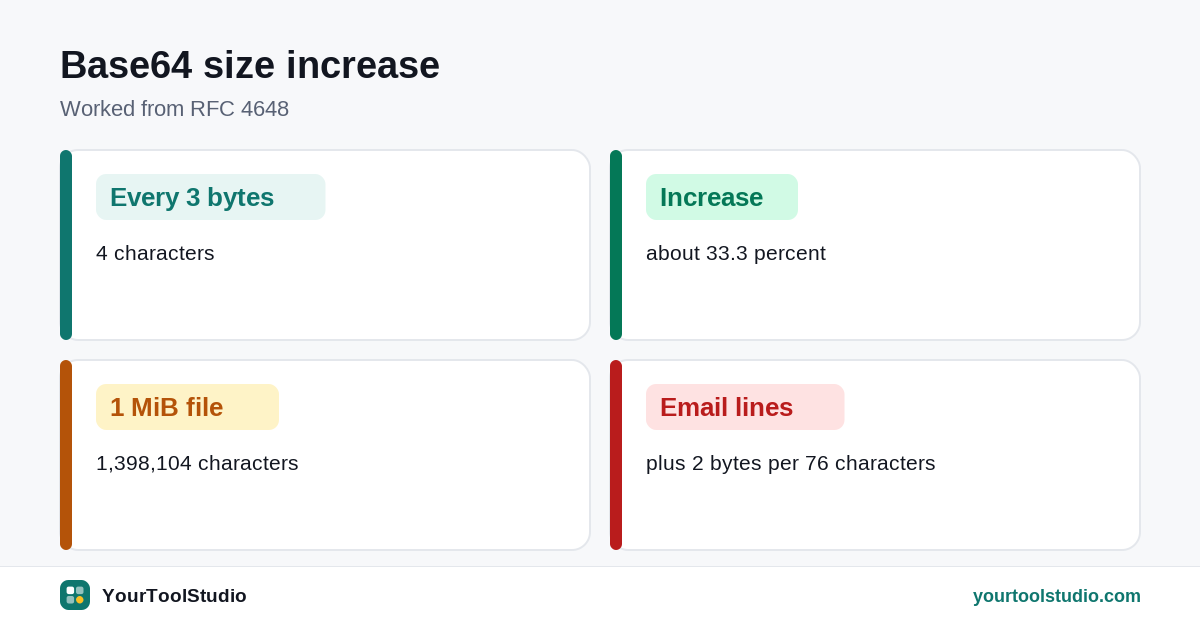
Base64 encoding makes data about 33.3 percent larger, because every 3 bytes of input become 4 characters of output. The exact encoded length of n bytes is 4 x ceil(n / 3) characters, so a 1 MiB file (1,048,576 bytes) becomes 1,398,104 characters. Each character is stored as 1 byte in ASCII or UTF-8, so characters and bytes are the same number here. Every figure below was calculated from RFC 4648, RFC 2045 and RFC 2397, checked on 24 November 2026.
The formula and where it comes from
RFC 4648 section 4 describes Base64 as taking 24-bit groups of input, three 8-bit bytes, and splitting each group into four 6-bit values, each written as one character from a 64-character alphabet. Four characters for three bytes is a ratio of 4 / 3, or 1.3333.
When the input length is not a multiple of 3, RFC 4648 still completes a full four-character unit at the end. If the last group holds one byte, the output ends in two characters and ==; if it holds two bytes, three characters and =. That padding is why small inputs grow far more than a third.
| Measure | Formula | Example for 100 bytes |
|---|---|---|
| Standard Base64 with padding | 4 x ceil(n / 3) | 136 characters |
| Without padding (allowed only where the spec using it says so) | ceil(4n / 3) | 134 characters |
| Padding characters | 0 if n mod 3 is 0, 2 if 1, 1 if 2 | 2 (100 mod 3 is 1) |
| MIME email body, 76 character lines | Base64 length + 2 x (lines - 1) | 138 bytes |
| Data URL | prefix length + Base64 length | 22 + 136 = 158 for a PNG |
| Largest input that fits L characters | floor(L / 4) x 3 | 1,000,000 characters fit 750,000 bytes |
Encoded size lookup table
Sizes in the first column are exact bytes. KiB and MiB mean 1,024 and 1,048,576 bytes; the 1,000 byte row shows the decimal kilobyte.
| Original size | Base64 characters | Padding | With 76 char MIME lines | Size ratio |
|---|---|---|---|---|
| 1 byte | 4 | == | 4 | 4.00 x |
| 2 bytes | 4 | = | 4 | 2.00 x |
| 3 bytes | 4 | none | 4 | 1.33 x |
| 10 bytes | 16 | == | 16 | 1.60 x |
| 100 bytes | 136 | == | 138 | 1.36 x |
| 1,000 bytes (1 KB) | 1,336 | == | 1,370 | 1.336 x |
| 1,024 bytes (1 KiB) | 1,368 | == | 1,402 | 1.336 x |
| 10 KiB (10,240 bytes) | 13,656 | == | 14,014 | 1.3336 x |
| 100 KiB (102,400 bytes) | 136,536 | == | 140,128 | 1.3334 x |
| 1 MiB (1,048,576 bytes) | 1,398,104 | == | 1,434,896 | 1.3333 x |
| 5 MiB (5,242,880 bytes) | 6,990,508 | = | 7,174,468 | 1.3333 x |
| 10 MiB (10,485,760 bytes) | 13,981,016 | == | 14,348,936 | 1.3333 x |
| 25 MiB (26,214,400 bytes) | 34,952,536 | == | 35,872,338 | 1.3333 x |
The MIME column assumes CRLF between lines and none after the last line; add 2 more bytes if your encoder ends with a line break. To check one of these rows yourself, encode a file with the Base64 Encode / Decode tool and compare the output length.
Extra characters from data URL prefixes
RFC 2397 defines the data URL as data:[<mediatype>][;base64],<data>, and notes the scheme is only useful for short values. The prefix adds a fixed number of characters on top of the Base64 length.
| Prefix | Characters |
|---|---|
| data:image/png;base64, | 22 |
| data:image/gif;base64, | 22 |
| data:image/jpeg;base64, | 23 |
| data:image/webp;base64, | 23 |
| data:font/woff2;base64, | 23 |
| data:image/svg+xml;base64, | 26 |
| data:application/pdf;base64, | 28 |
For a 30 KB PNG icon the prefix hardly matters, but the third added by Base64 does: inlining the image adds roughly 10 KB to your HTML or CSS. Shrinking the image first with Compress Image cuts the encoded size by the same proportion.
Line breaks in email and PEM
RFC 2045 requires the Base64 body of a MIME email to be written in lines of no more than 76 characters, not counting the CRLF line ending. That adds 2 bytes for every 76 characters, so encoded email attachments grow by about 36.8 percent instead of 33.3 percent. RFC 4648 notes that PEM uses 64 character lines, which works out at about 37.5 percent, and that encoders must not add line breaks unless the specification using Base64 asks for them.
Base64url
RFC 4648 section 5 defines a URL and filename safe alphabet, base64url, which uses - and _ in place of + and /. The size is the same, but RFC 4648 notes padding may be skipped when the length is known, as JSON Web Tokens do, which saves up to 2 characters.
Sources and dates
| Source | Checked | Used for |
|---|---|---|
| RFC 4648: The Base16, Base32, and Base64 Data Encodings | 24 November 2026 | 24-bit groups, padding cases, line feed rule, PEM 64 characters, base64url |
| RFC 2045: MIME Part One | 24 November 2026 | 76 character line limit, not counting CRLF |
| RFC 2397: The data URL scheme | 24 November 2026 | Data URL syntax |
Frequently asked questions
How much does Base64 increase file size?
By about 33.3 percent, because RFC 4648 turns every 3 bytes into 4 characters. Small inputs grow more because of padding, and email attachments grow about 36.8 percent once line breaks are added.
How big is a 1 MB file in Base64?
A 1,000,000 byte file becomes 1,333,336 characters. A 1 MiB file of 1,048,576 bytes becomes 1,398,104 characters, or 1,434,896 bytes in an email with 76 character lines.
Why does Base64 end with = or ==?
The equals signs are padding. RFC 4648 completes a 4 character unit at the end, adding == when the last group has 1 byte and = when it has 2.
How do I work out the original size from a Base64 string?
Take the length without line breaks, multiply by 3, divide by 4, then subtract the number of = signs at the end.