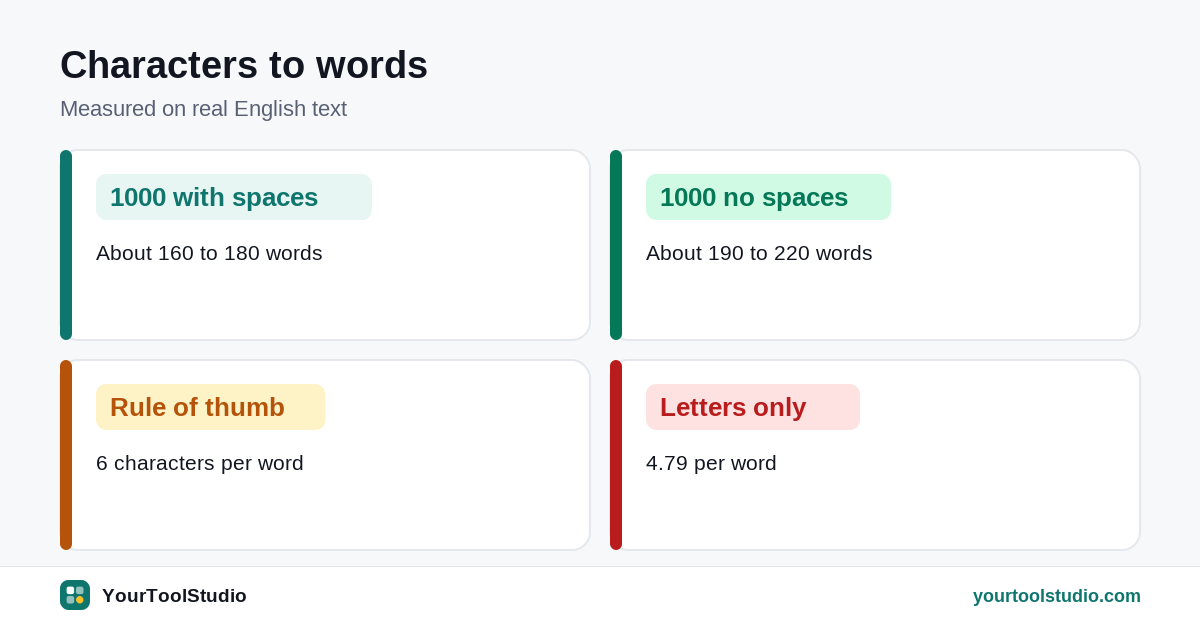
1000 characters is about 160 to 180 words of English if spaces are counted, and about 190 to 220 words if they are not. A quick rule is to divide a character count by 6 to get words when spaces count, or by 5 when they do not. The figures below come from our own measurements on seven texts, made on 24 November 2026, and from Peter Norvig's count of word lengths in the Google Books data.
Characters per word, measured
We pasted each text in with every run of whitespace collapsed to a single space, the way it would sit in a form field, and counted it the same way our Word Counter does: words with the browser's word segmenter, characters as visible symbols, punctuation included.
| Text | Words | Characters per word, with spaces | Without spaces | Letters only |
|---|---|---|---|---|
| Three of our own how-to guides (average) | 1,264 to 1,391 each | 5.48 | 4.47 | 4.35 |
| US Constitution, National Archives transcript | 4,663 | 5.87 | 4.87 | 4.73 |
| Wikipedia: Charles Dickens | 13,478 | 6.11 | 5.12 | 4.95 |
| Wikipedia: English language | 13,215 | 6.30 | 5.31 | 5.11 |
| Wikipedia: Photography | 7,352 | 6.44 | 5.46 | 5.29 |
Plain, practical writing with short words runs at about 5.5 characters per word including the space. Formal and encyclopedic writing, with longer words and more commas and brackets, runs at 6 to 6.4. For comparison, Norvig's analysis of 743,842,922,321 word mentions in Google Books found an average of 4.79 letters per word in running text. That count used letters A to Z only, so it matches the last column, not the character columns. He also found that distinct words in the dictionary average 7.60 letters, which is why some sources quote a much higher figure: that number counts each word once, not how often it is used.
Characters to words chart (spaces counted)
Use this chart when a limit counts spaces. Rates are rounded from the measurements above: 5.5 for plain writing, 5.9 for formal writing and 6.3 for dense writing.
| Characters | Plain writing (5.5) | Formal writing (5.9) | Dense writing (6.3) |
|---|---|---|---|
| 280 | 51 words | 47 words | 44 words |
| 500 | 91 words | 85 words | 79 words |
| 1,000 | 182 words | 169 words | 159 words |
| 1,500 | 273 words | 254 words | 238 words |
| 2,000 | 364 words | 339 words | 317 words |
| 2,500 | 455 words | 424 words | 397 words |
| 3,000 | 545 words | 508 words | 476 words |
| 4,000 | 727 words | 678 words | 635 words |
| 5,000 | 909 words | 847 words | 794 words |
| 10,000 | 1,818 words | 1,695 words | 1,587 words |
Characters to words chart (spaces not counted)
| Characters without spaces | Plain writing (4.5) | Formal writing (4.9) | Dense writing (5.3) |
|---|---|---|---|
| 1,000 | 222 words | 204 words | 189 words |
| 2,000 | 444 words | 408 words | 377 words |
| 3,000 | 667 words | 612 words | 566 words |
| 5,000 | 1,111 words | 1,020 words | 943 words |
Words to characters
Going the other way, multiply words by the rate. Use the dense column if you must not go over a limit.
| Words | Plain writing | Formal writing | Dense writing |
|---|---|---|---|
| 100 | 550 characters | 590 characters | 630 characters |
| 250 | 1,375 characters | 1,475 characters | 1,575 characters |
| 500 | 2,750 characters | 2,950 characters | 3,150 characters |
| 1,000 | 5,500 characters | 5,900 characters | 6,300 characters |
Why your count can differ
- Line breaks. Our measurements collapse every break to one space. Text with many short paragraphs uses more characters, because each break is counted too.
- Emoji and accented letters. In JavaScript, a thumbs up emoji has a length of 2 and a family emoji made of three people has a length of 8, although each shows as one symbol. A form that checks length that way can reject text that looks short enough. The Word Counter counts what you see, so each emoji is 1.
- Numbers, links and code. A web address or a long product code counts as one or a few words but many characters, so technical text gives fewer words per 1000 characters.
- Other languages. These rates are for English only. German compounds make words longer, and Chinese or Japanese text has no spaces at all.
Sources and dates
| Source | Checked | Used for |
|---|---|---|
| Peter Norvig: English Letter Frequency Counts, Mayzner Revisited | 24 November 2026 | 4.79 letters per word in running text, 7.60 for distinct words, corpus size |
| National Archives: The Constitution of the United States, a transcription | 24 November 2026 | Sample text for our measurement |
| Wikipedia articles Charles Dickens, English language and Photography | 24 November 2026 | Sample texts for our measurement (plain text, headings removed) |
| Node.js v26.13.0, Intl.Segmenter | 24 November 2026 | Word, character and emoji counts |
Frequently asked questions
How many words is 1000 characters?
About 160 to 180 words when spaces are counted, and about 190 to 220 words when they are not. Plain writing with short words reaches the top of that range.
How many words is 2000 characters?
About 320 to 360 words with spaces, or roughly 380 to 440 words without spaces.
How many characters is 500 words?
About 2,750 to 3,150 characters including spaces, depending on how long your words are.
Do spaces count as characters?
Usually yes, along with punctuation. If a limit says without spaces, only the visible symbols are counted. The Word Counter shows both numbers, so you can check either kind of limit.
What is the average word length in English?
Norvig found 4.79 letters per word in running text from Google Books. Counting the space and punctuation, our samples averaged 5.5 to 6.4 characters per word.