Making AI text sound human is not about sprinkling in typos or fake errors. No serious editor suggests that: it makes the writing worse and often does not work anyway. What does work is putting back what a language model leaves out, namely rhythm, specific detail and a point of view. It takes about as long as a careful edit, and much of it is deleting.
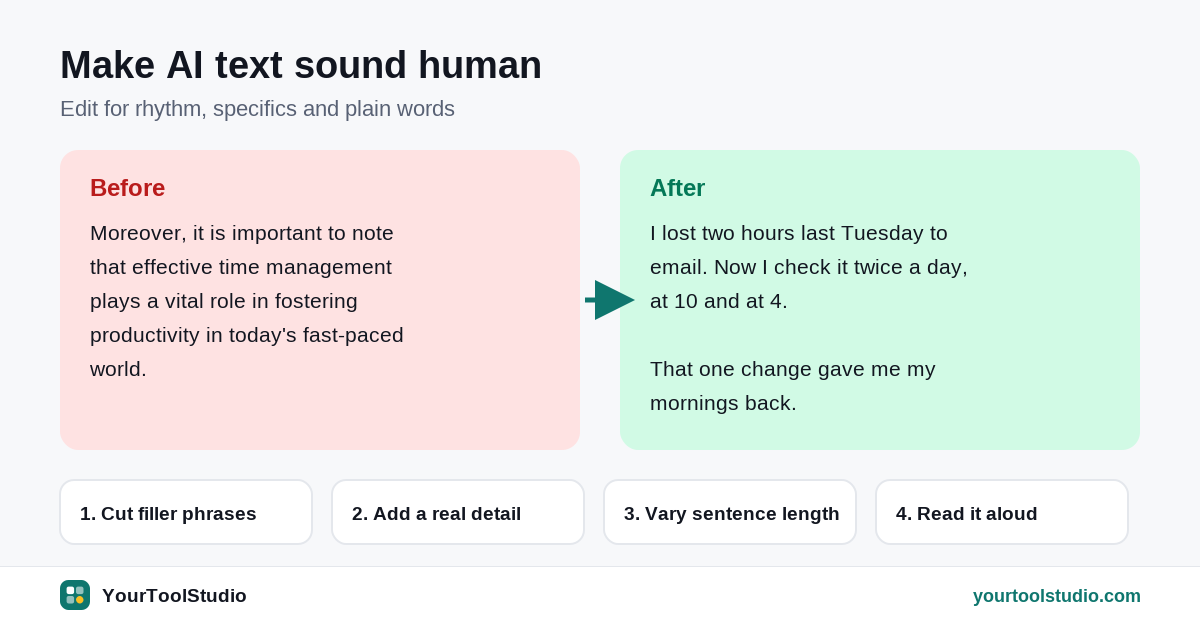
Why AI drafts read the way they do
A language model chooses the most likely next word, which gives its writing a smooth, expected feel. Sentences come out at similar lengths and paragraphs follow the same template. Detectors look for exactly these traits, built around two ideas worth knowing.
- Perplexity measures how surprising each word is. People choose slightly unexpected words; models choose the safest one.
- Burstiness measures how much sentence length varies. People mix a long, winding sentence with a four-word one. Models stay in one gear.
Each edit below increases one of these and moves the text closer to your own voice.
Six edits that do most of the work
1. Cut the warm-up sentence
Openers like "In today's fast-paced world" or "It is important to note that" say nothing. Begin where the real point begins. This alone removes much of the robotic feel.
2. Vary the rhythm
Find a paragraph where every sentence is the same length and break the pattern. Combine two sentences, shorten another to a fragment, shift the emphasis. Read it aloud and let your natural pauses decide the punctuation.
3. Remove filler linking words
Count the furthermores, moreovers, additionallys and in conclusions. More than one or two per page is too many. People say "also", "plus", or nothing at all.
4. Use contractions
Models default to formal phrasing like "you should not" and "I am". Real writing usually says "you shouldn't" and "I'm". Each contraction is a small sign that a person is talking.
5. Add something only you know
This is the most powerful edit and the one AI cannot imitate. Mention the actual tool you used, the real deadline, what surprised you, or take a clear position the model would have hedged. One concrete detail per section changes how the whole piece reads.
6. Read it aloud
This catches whatever is left. The sentence you trip over is usually the one the model wrote; the sentence that sounds like you is the one to keep.
Where a tool can help
A good humanizer does a structural first pass: it swaps flagged phrases for plainer ones, adds contractions and loosens stiff wording while keeping the facts untouched. You then add the specifics, because no tool knows your situation. Treat it as a head start and always do the final read yourself.
Our AI Humanizer works offline. Then add the details only you know.
A word about detectors
No editing method, manual or automatic, can promise a particular score on a particular checker. Detectors disagree with one another and are retrained often. The worthwhile goal is better writing that genuinely sounds like you, not a promise you will never be questioned. If a school or employer requires you to disclose AI help, rewriting does not change that.
Frequently asked questions
Why does AI writing feel robotic?
Mostly because of three habits: sentences that are all roughly the same length, predictable linking words like furthermore and moreover, and vague openers such as 'in today's world'. Human writing varies its rhythm and commits to specifics.
Can any tool guarantee my text will pass an AI detector?
No honest tool can. Detectors disagree with each other and change often. The realistic aim is clearer writing that reads as authentically yours, not a guaranteed result on a particular checker.
What are the quickest edits that help most?
Delete the generic first sentence, split up any run of long sentences, remove words like furthermore and moreover, add a couple of contractions, and include one real detail or opinion in each section.