A teacher reads an essay that does not feel quite right. A manager gets a report that seems too smooth. An editor wonders whether a submission came from a chatbot. In each case the question is the same: can software really tell? It can be genuinely useful if you understand what it measures, and genuinely harmful if you do not.
What detectors are really measuring
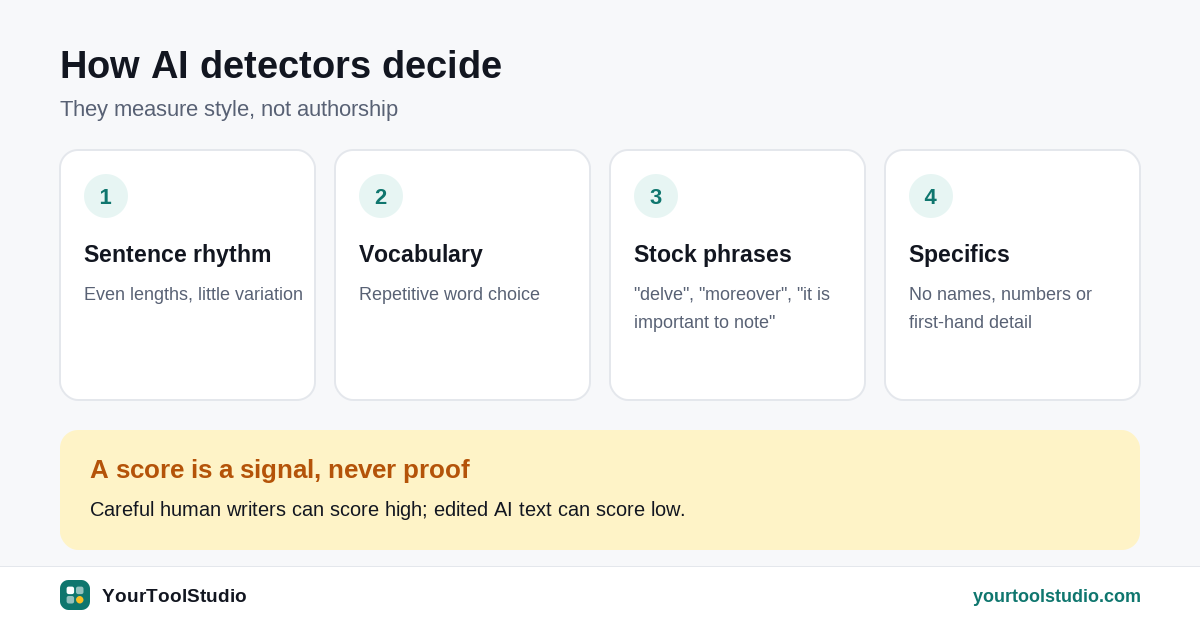
Most detectors are not reading a hidden watermark. They are doing statistics. A language model picks likely next words, so its output tends to be predictable in ways a checker can quantify.
- Perplexity: how surprising the word choices are. Very predictable wording reads as machine-like.
- Burstiness: how much sentence length varies. People swing between long and short; models tend to keep one steady rhythm.
- Structure: stock transitions, evenly shaped paragraphs and carefully balanced claims.
From those signals the tool produces a score. That leads to the most important limitation: it measures writing style, not who did the writing.
Signs you can spot yourself
You do not need software to notice the usual traits of AI writing. The dependable ones are sameness and a lack of real detail.
- Sentences of nearly identical length, paragraph after paragraph.
- Frequent linking words such as furthermore, moreover and "it is important to note".
- Constant hedging: some say this, others say that, it depends.
- Generic openings like "in today's fast-paced world".
- No specifics: no real names, figures, experiences or opinions you could not have predicted.
These are why AI text often feels flat even before any tool gets involved. A real author usually breaks at least one of these habits, often several times.
Where detection breaks down
Careful humans get flagged
Even sentence lengths and cautious, formal transitions are exactly what a diligent student or a technical writer tends to produce. Detectors mark human writing as AI more often than many people realise, and the people hurt most are those who tried hardest. A detector score should never be the deciding evidence against anyone.
Editing hides the pattern
Light editing removes the obvious tells, and a proper rewrite changes the statistical fingerprint completely. Some AI providers also add invisible statistical watermarks, which a rewrite removes too. So a clean result does not prove a human wrote the text; it only shows the text does not fit the patterns the detector expects.
Checking text without handing it over
If you want a second opinion on a passage, a checker can help, but think about where the text goes. Sending an unpublished draft or a disputed assignment to a server-based service has consequences. A browser-based detector analyses the text on your device, so it stays private and nothing is stored.
Our AI Detector runs offline in your browser. The text never leaves your device.
A sensible approach
Use a detector to decide which texts deserve a careful read, then do that read yourself: look for the signs above, look for real specifics, and talk to the writer. A short conversation reveals far more than any percentage.
Frequently asked questions
Can AI detectors be trusted?
They are helpful for deciding what to look at more closely, but not reliable enough to count as proof. They sometimes flag genuine human writing and miss AI text that has been edited, so a score should start a conversation, not end one.
Why would a detector say my own writing is AI?
Detectors look for statistical patterns, and even sentence lengths and formal linking words are also typical of careful human writers. That is why essays and technical documents get falsely flagged most often.
Is my text sent anywhere when I use an AI detector?
That depends on the tool. Many online checkers upload text to their servers. Ours runs entirely in your browser, so whatever you paste stays on your device.