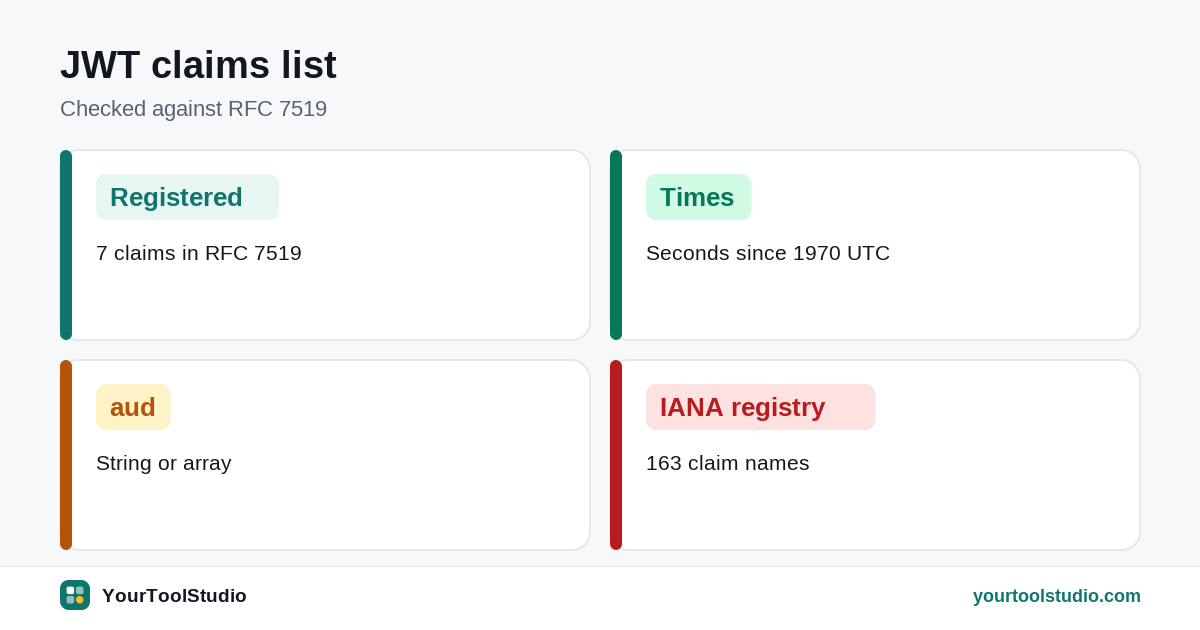
RFC 7519 defines seven registered JWT claims: iss (issuer), sub (subject), aud (audience), exp (expiration time), nbf (not before), iat (issued at) and jti (JWT ID). All seven are optional in the base standard, and each application decides which ones it requires. The details below come from RFC 7519, the IANA JSON Web Token Claims registry and OpenID Connect Core 1.0, all checked on 24 November 2026.
The seven registered claims
| Claim | Name | Value type | What it means | How it is checked |
|---|---|---|---|---|
iss | Issuer | Case-sensitive StringOrURI | Who issued the token | Application specific, usually compared with the expected issuer |
sub | Subject | Case-sensitive StringOrURI | Who the token is about, often a user ID | Must be unique within the issuer, or globally unique |
aud | Audience | Array of StringOrURI, or one string | Who the token is meant for | A recipient that is not listed must reject the token |
exp | Expiration Time | NumericDate (number) | When the token stops being valid | Current time must be before exp |
nbf | Not Before | NumericDate (number) | When the token starts being valid | Current time must be on or after nbf |
iat | Issued At | NumericDate (number) | When the token was issued | Used to work out the age of the token |
jti | JWT ID | Case-sensitive string | A unique ID for this token | Can be stored to stop the same token being replayed |
RFC 7519 says none of these claims are meant to be mandatory in every case; they are a shared starting point. The names are only three letters long because a core goal of JWTs is to stay compact.
Value types in plain words
- NumericDate is a JSON number of seconds since 1970-01-01T00:00:00Z UTC, ignoring leap seconds, the same count as a Unix timestamp. It is seconds, not milliseconds, and RFC 7519 allows non-integer values. For example, 1795478400 is 24 November 2026 at 00:00 UTC.
- StringOrURI is any string, with one rule: if it contains a colon, it must be a valid URI. Values are compared as case-sensitive strings with no changes, so
https://Example.comandhttps://example.comdo not match. - aud is normally an array, such as
["api", "admin"], but when a token has a single audience it may be a plain string. Code that reads aud should accept both forms.
Checking exp and nbf with leeway
RFC 7519 lets implementers allow a small leeway, usually no more than a few minutes, to cover clocks that are slightly out of step. A worked example with a 60 second leeway:
| Claim in token | Server time | Result |
|---|---|---|
| exp 1795478400 (00:00:00 UTC) | 23:59:30 the day before | Accepted: before exp |
| exp 1795478400 | 00:00:00 | Rejected without leeway: a token must not be accepted at or after exp |
| exp 1795478400 | 00:00:45 | Accepted with 60 s leeway, rejected without |
| nbf 1795478400 | 23:59:30 the day before | Rejected without leeway, accepted with 60 s |
| nbf 1795478400 | 00:00:00 | Accepted: on or after nbf |
A token whose exp has passed is rejected even if its signature is valid. If every token seems to expire immediately, the usual cause is milliseconds: a value such as 1795478400000 is read as a date tens of thousands of years away, while a value in seconds compared with a millisecond clock looks long expired. Our Unix timestamp guide shows how to tell the two apart, and the Unix Timestamp Converter turns either into a date.
Public and private claims
RFC 7519 sorts claim names into three classes. Registered names are those in the IANA JSON Web Token Claims registry. Public names are new names that are either registered with IANA or made collision resistant, for example by using a URI you control such as https://example.com/claims/plan. Private names are anything else that the issuer and recipient agree on, such as role or tenant; the RFC warns they can collide and should be used with caution. Claim names in one token must be unique, and any claim a program does not understand must be ignored unless the application says otherwise.
Common claims from the IANA registry
The IANA registry listed 163 claim names when it was downloaded on 24 November 2026. These are the ones you are most likely to meet in login and API tokens:
| Claim | Description in the registry | Defined in |
|---|---|---|
name, given_name, family_name | Full name, first name, surname | OpenID Connect Core 1.0, section 5.1 |
email, email_verified | Preferred email address, and whether it has been verified | OpenID Connect Core 1.0, section 5.1 |
nonce | Value that ties a client session to an ID Token | OpenID Connect Core 1.0, section 2; RFC 9449 |
auth_time | Time when the authentication occurred | OpenID Connect Core 1.0, section 2 |
azp | Authorized party the ID Token was issued to | OpenID Connect Core 1.0, section 2 |
acr, amr | Authentication context class and methods used | OpenID Connect Core 1.0, section 2 |
sid | Session ID | OpenID Connect Front-Channel Logout 1.0 |
cnf | Confirmation, for proof of possession keys | RFC 7800 |
scope, client_id, act | Scope values, client identifier, actor | RFC 8693 |
roles, groups, entitlements | Roles, groups and entitlements | RFC 7643; RFC 9068 |
Claims an OpenID Connect ID Token must have
OpenID Connect Core 1.0 section 2 makes five claims required in every ID Token: iss, sub, aud, exp and iat. It adds stricter rules than RFC 7519: iss must be an https URL with no query or fragment, sub must not be longer than 255 ASCII characters and must never be reassigned, and aud must contain the client_id of the app. auth_time becomes required when the login request asked for max_age, and nonce must match the value the app sent.
Read the claims in a token
Paste a token into the JWT Decoder to see its header and payload. It shows exp, iat, nbf and auth_time as readable dates, says whether the token has expired or is not valid yet, and can check the signature with your key, all in the browser. Remember that the payload is only Base64url encoded, not encrypted, so never put secrets in claims; see how Base64 encoding changes size for why tokens grow as you add claims.
Sources and dates
| Page | Read | Used for |
|---|---|---|
| RFC 7519: JSON Web Token (JWT) | 24 November 2026 | Registered claims, NumericDate, StringOrURI, leeway, claim classes |
| IANA JSON Web Token Claims registry | 24 November 2026 | Claim names, descriptions, defining documents, count of 163 |
| OpenID Connect Core 1.0 | 24 November 2026 | Required ID Token claims and their extra rules |
Frequently asked questions
What are the standard JWT claims?
RFC 7519 registers seven: iss (issuer), sub (subject), aud (audience), exp (expiration time), nbf (not before), iat (issued at) and jti (JWT ID). All of them are optional in the base standard.
Is exp in seconds or milliseconds?
Seconds. exp, nbf and iat are NumericDate values, the number of seconds since 1 January 1970 UTC, the same as a Unix timestamp.
Can aud be a string instead of an array?
Yes. RFC 7519 says aud is normally an array of strings, but a token with one audience may use a single string, so readers should accept both.
Which claims are required in a JWT?
None in RFC 7519 itself. Each application decides. OpenID Connect ID Tokens must contain iss, sub, aud, exp and iat.
What is the difference between public and private claims?
Public claim names are registered with IANA or made collision resistant, such as a URI you own. Private names are agreed between issuer and recipient and can collide.