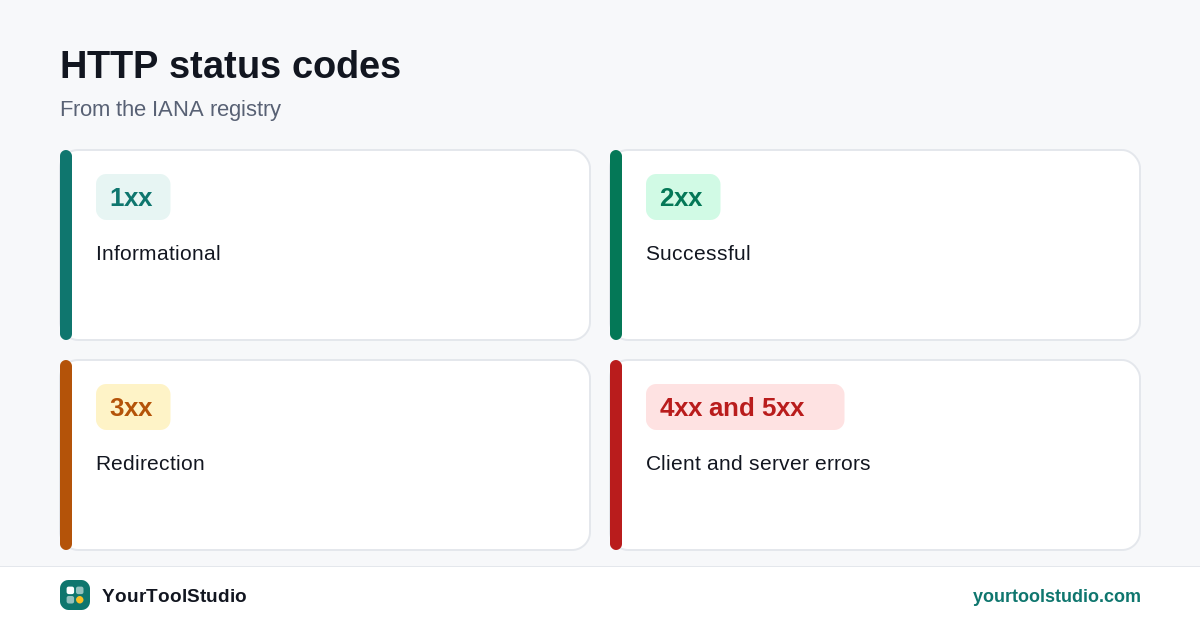
An HTTP status code is the three-digit number a server sends back with every response, and its first digit tells you the class: 1xx informational, 2xx successful, 3xx redirection, 4xx client error and 5xx server error. RFC 9110 says all valid codes fall between 100 and 599, and the last two digits have no categorizing role. The full list below comes from the IANA HTTP Status Code Registry, which was checked on 23 November 2026, and the notes come from the RFCs it cites.
The five classes
| Class | Meaning in RFC 9110 | Typical cause |
|---|---|---|
| 1xx Informational | The request was received, continuing process | Interim reply before the final response |
| 2xx Successful | The request was successfully received, understood and accepted | The request worked |
| 3xx Redirection | Further action needs to be taken to complete the request | The resource moved or a cached copy is still valid |
| 4xx Client Error | The request contains bad syntax or cannot be fulfilled | Wrong address, missing login, bad input or too many requests |
| 5xx Server Error | The server failed to fulfil an apparently valid request | A crash, an overloaded server or a failed upstream |
RFC 9110 also says a client that meets a code it does not know must treat it like the x00 code of the same class. An unknown 471, for example, is handled as 400 Bad Request.
Full list of registered status codes
| Code | Name | Defined in |
|---|---|---|
| 100 | Continue | RFC 9110 |
| 101 | Switching Protocols | RFC 9110 |
| 102 | Processing | RFC 2518 |
| 103 | Early Hints | RFC 8297 |
| 104 | Upload Resumption Supported (temporary registration) | draft-ietf-httpbis-resumable-upload |
| 200 | OK | RFC 9110 |
| 201 | Created | RFC 9110 |
| 202 | Accepted | RFC 9110 |
| 203 | Non-Authoritative Information | RFC 9110 |
| 204 | No Content | RFC 9110 |
| 205 | Reset Content | RFC 9110 |
| 206 | Partial Content | RFC 9110 |
| 207 | Multi-Status | RFC 4918 (WebDAV) |
| 208 | Already Reported | RFC 5842 (WebDAV) |
| 226 | IM Used | RFC 3229 |
| 300 | Multiple Choices | RFC 9110 |
| 301 | Moved Permanently | RFC 9110 |
| 302 | Found | RFC 9110 |
| 303 | See Other | RFC 9110 |
| 304 | Not Modified | RFC 9110 |
| 305 | Use Proxy | RFC 9110 |
| 306 | (Unused), reserved | RFC 9110 |
| 307 | Temporary Redirect | RFC 9110 |
| 308 | Permanent Redirect | RFC 9110 |
| 400 | Bad Request | RFC 9110 |
| 401 | Unauthorized | RFC 9110 |
| 402 | Payment Required | RFC 9110 |
| 403 | Forbidden | RFC 9110 |
| 404 | Not Found | RFC 9110 |
| 405 | Method Not Allowed | RFC 9110 |
| 406 | Not Acceptable | RFC 9110 |
| 407 | Proxy Authentication Required | RFC 9110 |
| 408 | Request Timeout | RFC 9110 |
| 409 | Conflict | RFC 9110 |
| 410 | Gone | RFC 9110 |
| 411 | Length Required | RFC 9110 |
| 412 | Precondition Failed | RFC 9110 |
| 413 | Content Too Large | RFC 9110 |
| 414 | URI Too Long | RFC 9110 |
| 415 | Unsupported Media Type | RFC 9110 |
| 416 | Range Not Satisfiable | RFC 9110 |
| 417 | Expectation Failed | RFC 9110 |
| 418 | (Unused), reserved | RFC 9110 |
| 421 | Misdirected Request | RFC 9110 |
| 422 | Unprocessable Content | RFC 9110 |
| 423 | Locked | RFC 4918 (WebDAV) |
| 424 | Failed Dependency | RFC 4918 (WebDAV) |
| 425 | Too Early | RFC 8470 |
| 426 | Upgrade Required | RFC 9110 |
| 428 | Precondition Required | RFC 6585 |
| 429 | Too Many Requests | RFC 6585 |
| 431 | Request Header Fields Too Large | RFC 6585 |
| 451 | Unavailable For Legal Reasons | RFC 7725 |
| 500 | Internal Server Error | RFC 9110 |
| 501 | Not Implemented | RFC 9110 |
| 502 | Bad Gateway | RFC 9110 |
| 503 | Service Unavailable | RFC 9110 |
| 504 | Gateway Timeout | RFC 9110 |
| 505 | HTTP Version Not Supported | RFC 9110 |
| 506 | Variant Also Negotiates | RFC 2295 |
| 507 | Insufficient Storage | RFC 4918 (WebDAV) |
| 508 | Loop Detected | RFC 5842 (WebDAV) |
| 510 | Not Extended (marked obsoleted) | RFC 2774 |
| 511 | Network Authentication Required | RFC 6585 |
Every number not listed, such as 419, 420, 427, 430 or 509, is unassigned in the registry. Codes you may see in logs that are missing here, for example 499 or 520, are product-specific and not part of the standard. The registry lists 104 as a temporary registration for resumable uploads, with an expiry date of 13 November 2026 shown next to it, so check its current status before relying on it.
Codes that need a specific header
| Code | What the RFC asks for |
|---|---|
| 401 Unauthorized | The server must send a WWW-Authenticate header with at least one challenge |
| 405 Method Not Allowed | The origin server must send an Allow header listing the methods it accepts |
| 301, 302, 307, 308 | The server should send a Location header with the new address |
| 413 Content Too Large | If the problem is temporary, the server should send Retry-After |
| 429 Too Many Requests | May include Retry-After to say how long to wait (RFC 6585) |
| 503 Service Unavailable | The server may send Retry-After to suggest when to try again |
Pairs that are easy to mix up
- 301 versus 308: both are permanent. RFC 9110 notes that, for historical reasons, a browser may turn a POST into a GET after a 301 or 302. Use 308 when the method must stay the same.
- 302 versus 307: both are temporary. With 307 the client must not change the method.
- 401 versus 403: 401 means valid credentials are missing or were refused and comes with a challenge. 403 means the server understood the request and refuses it; sending the same credentials again will not help.
- 404 versus 410: 404 says nothing about whether the absence is temporary. 410 tells clients the removal is likely permanent and that links to it should be removed.
- 400 versus 422: 400 is for a request the server cannot or will not process, such as malformed syntax. 422 is for content whose syntax is correct but whose instructions cannot be processed.
- 502 versus 504: both come from a gateway or proxy. 502 means the upstream reply was invalid; 504 means the upstream did not reply in time.
Which responses caches reuse by default
RFC 9110 names 200, 203, 204, 206, 300, 301, 308, 404, 405, 410, 414 and 501 as heuristically cacheable. A cache may store and reuse these without explicit freshness headers, so a 404 served during a broken deploy can keep appearing after the fix. Send a Cache-Control header on error pages if that matters.
For 414 and the limits behind it, see URL length limits. For the Content-Type values that cause 415, see document MIME types.
Sources and dates
| Page | Checked | Used for |
|---|---|---|
| IANA HTTP Status Code Registry | 23 November 2026 | The full list of codes, names, unassigned ranges and defining RFCs |
| RFC 9110: HTTP Semantics | 23 November 2026 | Classes, unknown code handling, header requirements, redirect behaviour, 418 and heuristic caching |
| RFC 6585: Additional HTTP Status Codes | 23 November 2026 | 428, 429, 431 and 511 |
Frequently asked questions
How many HTTP status codes are there?
The IANA registry checked on 23 November 2026 lists 64 assigned values from 100 to 511, including the reserved 306 and 418 and the temporary 104. All other numbers from 100 to 599 are unassigned.
What do the 4xx and 5xx codes mean?
4xx codes mean the problem is on the client side, such as a wrong address, missing login or invalid input. 5xx codes mean the server failed to handle an apparently valid request.
Is 418 I am a teapot a real status code?
No. RFC 9110 says 418 came from an April 1 joke RFC and is now reserved as (Unused) in the IANA registry, so it cannot be assigned to anything else for now.
What is the difference between 301 and 308?
Both mean the resource moved permanently. After a 301 a browser may change a POST into a GET, while a 308 keeps the original method.
What should a client do with an unknown status code?
RFC 9110 says to treat it like the x00 code of its class, so an unknown 4xx is handled as 400 Bad Request and an unknown 5xx as 500.
Which header should a 429 response include?
RFC 6585 says a 429 response may include a Retry-After header telling the client how long to wait before trying again.