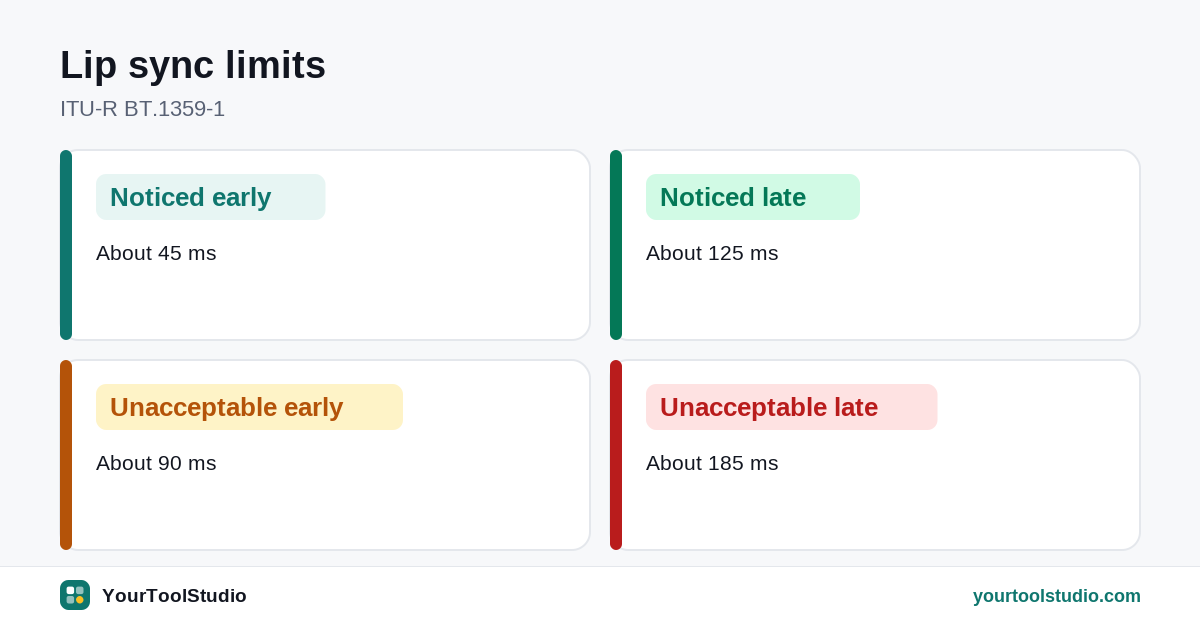
Viewers start to notice bad lip sync when sound arrives about 45 ms before the picture or about 125 ms after it, and find it unacceptable at about 90 ms early or 185 ms late, according to subjective tests reported in ITU-R Recommendation BT.1359-1. People are far more sensitive to sound that comes early than to sound that comes late. Both standards below were opened and read on 22 November 2026.
Perception thresholds
ITU-R BT.1359-1 (1998) reports tests in Japan, Switzerland and Australia with very similar results. Its sign convention matters: a positive number means the sound is advanced, that is, heard before the matching picture.
| Threshold | Sound early (advanced) | Sound late (delayed) | What it means |
|---|---|---|---|
| Detectability | About 45 ms | About 125 ms | The point where viewers start to notice |
| Acceptability | About 90 ms | About 185 ms | The point where it becomes unacceptable |
| Gap between the two | About 45 ms | About 60 ms | One grade on the five grade impairment scale |
The recommendation adds that the span between the two just detectable limits is about 170 ms, and that within it there is a plateau where viewers cannot tell any difference at all.
Recommended limits for broadcasters
| Standard and stage | Sound early, at most | Sound late, at most |
|---|---|---|
| ITU-R BT.1359-1: whole chain, source to viewer | 90 ms | 185 ms |
| ITU-R BT.1359-1: image source to the final programme source selection point | 25 ms | 100 ms |
| ITU-R BT.1359-1: final selection point to transmitter input | 22.5 ms | 30 ms |
| ITU-R BT.1359-1: each downstream segment not controlled by the broadcaster, if errors cannot be corrected | 2 ms | 2 ms |
| EBU R37-2007: each stage of production | 5 ms | 15 ms |
| EBU R37-2007: any output intended for emission, end to end | 40 ms | 60 ms |
EBU R37 says its figures come from tests of the delay at which lip sync failure becomes perceptible to 50 percent of observers, and that particular care is needed in HD production. It also says audio and video should be kept coincident in the file or stream rather than shifted in advance to make up for later processing delays.
The same limits in video frames
Editors usually move audio in frames. One frame lasts 1,000 divided by the frame rate in milliseconds: 41.7 ms at 24 fps, 40 ms at 25 fps, 33.3 ms at 30 fps and 16.7 ms at 60 fps. Dividing the thresholds by those durations gives:
| Offset | 24 fps | 25 fps | 30 fps | 60 fps |
|---|---|---|---|---|
| 40 ms early (EBU emission limit) | 1.0 frame | 1.0 frame | 1.2 frames | 2.4 frames |
| 45 ms early (noticed) | 1.1 frames | 1.1 frames | 1.4 frames | 2.7 frames |
| 60 ms late (EBU emission limit) | 1.4 frames | 1.5 frames | 1.8 frames | 3.6 frames |
| 90 ms early (unacceptable) | 2.2 frames | 2.3 frames | 2.7 frames | 5.4 frames |
| 125 ms late (noticed) | 3.0 frames | 3.1 frames | 3.8 frames | 7.5 frames |
| 185 ms late (unacceptable) | 4.4 frames | 4.6 frames | 5.6 frames | 11.1 frames |
In practice, sound that is one frame early at 24, 25 or 30 fps is already close to the point where viewers notice, while sound a frame or two late usually goes unnoticed. If you have to choose, leave audio slightly late rather than early.
Using the chart
- An offset that stays the same through the whole video can be shifted by that amount; one that grows over time usually comes from a variable frame rate and needs re-exporting at a constant rate.
- Bluetooth speakers and TV processing add their own delay on top of the file, so test on built in speakers before changing the file.
- To shift audio that runs ahead of the picture, add the soundtrack with a later start in Add Audio to Video, after saving it with MP4 to MP3.
- For the causes and step by step fixes, see why video audio is out of sync.
Sources and when they were checked
Both were opened and read on 22 November 2026: ITU-R BT.1359-1, Relative timing of sound and vision for broadcasting (in force, approved November 1998), for the detectability and acceptability thresholds and the chain limits; and EBU Technical Recommendation R37-2007, The relative timing of the sound and vision components of a television signal, for the per stage and emission limits. Frame figures are our own arithmetic from those limits, rounded to one decimal place.
Frequently asked questions
How much audio delay is noticeable?
ITU-R BT.1359-1 reports that viewers notice sound about 45 ms early or about 125 ms late on average.
What is the acceptable lip sync tolerance?
The ITU acceptability thresholds are about 90 ms with sound early and 185 ms with sound late. EBU R37 asks broadcasters to stay within 40 ms early and 60 ms late at emission.
Is audio early or late worse?
Early is worse. Viewers notice sound that leads the picture at about 45 ms, but sound that lags only at about 125 ms.
How many frames out of sync is noticeable?
At 25 fps, about 1.1 frames of early sound or 3.1 frames of late sound, based on the ITU detectability thresholds.
What does a positive offset mean in ITU-R BT.1359?
A positive value means the sound is advanced, heard before the matching picture.